Key Takeaways
The clearest of all the AI travel planning trends 2026 has produced so far is adoption speed: Phocuswright reported 56% of U.S. leisure travelers had used AI for at least one trip, up from 43% roughly nine months earlier.
In India specifically, Agoda's 2026 Travel Outlook Report found 33% of travelers already use AI to plan trips, with 68% saying they're likely to use it for their next one.
Agentic AI (tools that book, not just suggest) is arriving fast on the industry side, but consumer trust lags far behind. Only around 2% of U.S. consumers say they're willing to let AI complete a booking autonomously.
Satisfaction is high among people who've actually tried it. McKinsey found 84% of travelers who used gen AI for a travel task said it improved their experience, even though under a third of all travelers had tried it.
Tools built for a specific region and traveler type, like TripPlannerAI for Indian destinations, are positioned to benefit most from this shift, since generic global AI answers still struggle with local nuance.
What Are AI Travel Planning Trends in 2026?
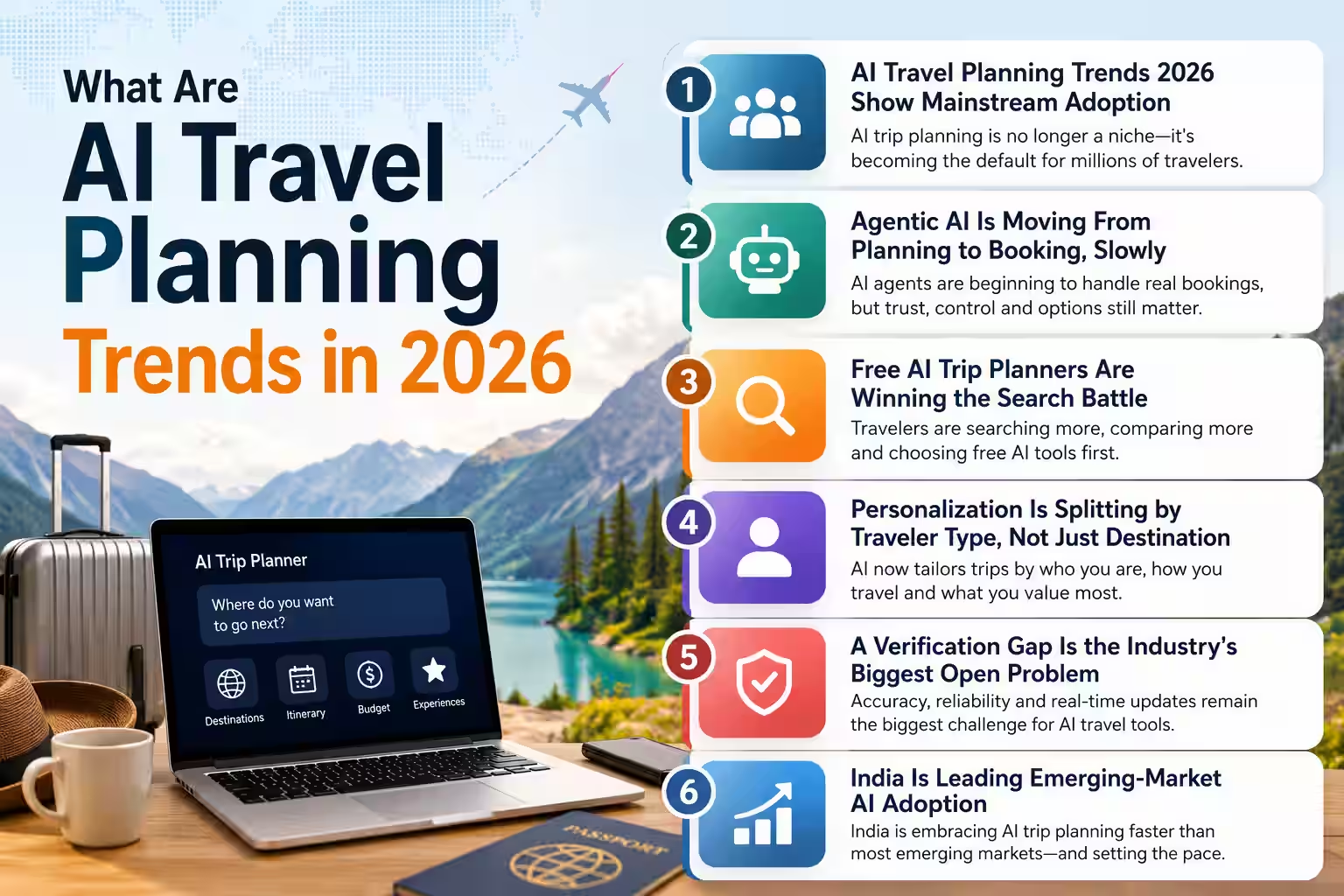
AI travel planning trends in 2026 refer to the measurable shifts in how travelers research, build, and increasingly book trips using artificial intelligence tools, from chatbot-style itinerary generators to newer "agentic" systems that can complete bookings with limited human input. Three shifts define the year so far: adoption has crossed from early-adopter territory into the mainstream, the technology itself is moving from suggestion to action, and a visible trust gap has opened between the two.
Trend 1: AI Travel Planning Trends 2026 Show Mainstream Adoption
Of all the AI travel planning trends 2026 has surfaced, adoption is the one with the clearest numbers behind it. Phocuswright reported that 56% of U.S. leisure travelers used AI for at least one trip in 2026, up from 43% just nine months earlier, a jump the firm described as the fastest behavioral shift the travel industry has tracked in more than a decade. Separate research from TakeUp found that 90% of travelers are now aware AI can help plan or book travel, even though only about 38% have actually used it themselves, a gap that signals habit rather than distrust.
The generational pattern is narrowing too. Global Rescue's 2025 to 2026 tracking found nearly two-thirds of travelers under 45 had used AI for trip recommendations, compared with about 44% of Gen X travelers and 29% of Baby Boomers, up from 18% the year before. Adoption is still younger-skewed, but the older cohorts are catching up faster than most predictions expected.
Trend 2: Agentic AI Is Moving From Planning to Booking, Slowly
The most-discussed AI travel planning trend of 2026 is "agentic AI," systems built to search, compare, and complete a booking with minimal manual steps rather than just generating a list of suggestions. Google has been developing agentic booking tools inside AI Mode in partnership with Booking.com, Expedia, Marriott, IHG, and Choice Hotels. Sabre, PayPal, and Mindtrip announced a partnership aimed at closing the entire search-to-payment loop inside one conversational interface. Malaysia Airlines, United, Icelandair, and Southwest are among the airlines already running production agentic tools for service and rebooking tasks.
The catch is consumer trust. Skift's 2026 reporting found that while roughly 80% of travel executives plan to deploy agentic AI at scale, only about 2% of U.S. consumers say they're currently willing to let AI complete a purchase autonomously. Business travel is adopting agentic AI faster than leisure travel, largely because corporate travel programs already have policy guardrails and approval steps built in, which gives travelers a safety net leisure trips don't have.
Trend 3: Free AI Trip Planners Are Winning the Search Battle
One of the more commercially useful AI travel planning trends 2026 has produced comes from search behavior, not survey data. A 2026 search-behavior analysis from MonkeyTravel, based on over 1.1 million travel-related search impressions, found that queries for "free AI trip planner" convert to clicks at roughly 5.9%, more than three times the rate of the generic "AI trip planner" search. Travelers in 2026 have effectively decided that AI trip planning is something that shouldn't cost money upfront, and their search behavior reflects that. For any AI trip planner, including regional tools like TripPlannerAI, this trend explains why a usable free itinerary draft matters more for growth than gating basic planning behind a paywall.
Trend 4: Personalization Is Splitting by Traveler Type, Not Just Destination
Among the AI travel planning trends 2026 has made visible, this is the one competitors talk about least and travelers feel the most. Early AI trip planners treated personalization as a single slider: budget, high to low. In 2026, the more competitive tools weight inputs differently depending on who's actually traveling. A solo traveler's safety and social-context needs, a family's pacing and downtime needs, and a business traveler's schedule-protection needs are different planning problems, not different settings on the same problem. Real-world testing backs this up: when Medium contributor Milan Patel tested seven AI trip planners against a group-conflict scenario (one traveler wanting Florence, another wanting a Pompeii day trip), the tools that resolved the conflict well were the ones built around traveler-type logic, not just budget inputs.
Trend 5: A Verification Gap Is the Industry's Biggest Open Problem
Not every one of the AI travel planning trends 2026 has produced is a growth story. Adoption and satisfaction are both climbing, but so is a documented accuracy problem. Simon-Kucher's 2026 Travel Trends report found that among travelers who came away dissatisfied with an AI tool's answers, 52% said the response itself was inaccurate, not just unhelpful. TakeUp's research found similar friction: 55% of surveyed travelers hadn't yet used AI for planning, citing accuracy, real-time pricing, and personalization as their main hesitations. The practical trend for 2026 isn't "AI travel planning is now reliable enough to trust blindly." It's "AI travel planning is now good enough that verification, not avoidance, is the sensible default."
Trend 6: India Is Leading Emerging-Market AI Adoption
Among global markets, India stands out as one of the fastest-moving in this shift, and it's a distinct thread within the broader AI travel planning trends 2026 has revealed. Agoda's 2026 Travel Outlook Report found that 33% of Indian travelers already use AI to plan trips, and 68% say they're likely to use it for their next one, roughly double the current usage rate. Trust is unusually high too: 88% of Indian respondents said they trust or feel neutral about AI-generated travel recommendations, and 53% said they rely on AI trip planning apps completely. Separately, Allianz Partners' 2026 Global Travel Confidence Index found that 82% of Indian travelers already use or plan to use AI tools for vacation planning, well above the 74% global travel-intent average the same survey recorded.
Within that Indian data, the specific use cases travelers want from AI map closely to what a segment-aware planner needs to deliver: recommendations for attractions and activities (38%), personalized itinerary creation (37%), destination suggestions (29%), dining recommendations (23%), and budget management (22%). This is the exact set of inputs TripPlannerAI is built around for Indian trips, structuring a day-by-day plan by mood, budget, food preference, and pace rather than returning a generic global template.
What These Trends Mean for Each Traveler Type
Solo travelers: benefit most from Trend 4, since safety-aware, social-context personalization is now a real differentiator between tools rather than an afterthought.
Couples: benefit from the free-tool trend (Trend 3), since a rough romantic-getaway draft costs nothing to generate and refine.
Families: are the group most affected by the verification gap (Trend 5). Downtime pacing and age-appropriate scheduling still need a human check before booking.
Groups: stand to gain the most once agentic AI matures (Trend 2), since resolving multi-person budget and interest conflicts is exactly the kind of multi-step task agentic systems are being built for.
Backpackers: are underserved by most agentic booking rollouts so far, since multi-city, multi-week route optimization gets less industry investment than single-trip corporate or luxury bookings.
Business travelers: are the current leading edge of agentic AI adoption (Trend 2), thanks to built-in corporate approval workflows that leisure travelers don't have.
Real-World Example: The 2026 Trend Gap in Practice
A France-focused AI travel test run by Food & Drink Destinations in 2026 illustrates the trend gap well. The publication built a full trip itinerary using an AI planner and found the tool got the shape of the trip right (logical routing, reasonable pacing, relevant regional food suggestions) but got specific details wrong, including at least one restaurant that had closed and price estimates that didn't reflect current rates. That's the 2026 pattern in miniature: AI travel planning trends point toward tools that are structurally reliable but still need a manual accuracy check on anything time-sensitive, which lines up exactly with the Simon-Kucher and TakeUp findings on the verification gap above.
Where 2026's AI Travel Planning Trends Still Fall Short
Real-time pricing drift. Even strong AI itineraries can quote prices or availability that shifted after the tool's data was last updated.
Local nuance in emerging markets. Global AI tools trained mostly on Western travel data still under-perform on region-specific detail like Indian festival timing or intercity transit realities, which is why regionally focused tools have room to compete.
Autonomous booking trust. With consumer willingness to let AI work independently still around 2%, most 2026 "agentic" rollouts remain assistive rather than fully autonomous in practice, whatever the marketing language claims.
Group conflict resolution. Multi-person trips with competing interests are still one of the harder problems for AI tools to solve well, though this is improving.
How to Use AI Travel Planning Trends 2026 as a Traveler
Treat AI output as a first draft, always. Given the documented accuracy gap, verify prices, hours, and availability independently before booking anything time-sensitive.
Match the tool to your traveler type. A generic global AI chatbot answer is a weaker starting point than a planner built around your specific trip type (solo, family, business, and so on).
Use free tools first. The 2026 search data shows free-tier AI planners are both more common and more trusted as a starting point than paywalled ones.
Keep a human checkpoint before payment. Given how low consumer trust in autonomous booking still is, this isn't overcaution, it's the current majority behavior.
Expect regional tools to outperform generalists on local trips. For India-specific travel, a planner built around Indian destinations, festivals, and transit realities will typically beat a global AI chatbot's generic answer.